
Why Wealth Firms Need to Own Their Infrastructure with Kevin Mitchell
This week, Jack Sharry talks with Kevin Mitchell, CEO and Co-Founder of Graphene. After nearly two decades building and operating regulated wealth platforms across the UK and Europe, Kevin co-founded Graphene to help wealth firms take greater control of the infrastructure on which their businesses depend.
Jack and Kevin examine why platform infrastructure has become an enterprise-level strategic decision. Kevin outlines how owning more of the value chain can give wealth firms greater authority over their data, operating model, client experience, and economics while still allowing them to use institutional partners for capabilities such as custody. They also discuss Graphene’s approach to data sovereignty, the relationship between infrastructure and enterprise value, and why firms should establish secure, interoperable foundations before applying AI.
What Kevin has to say
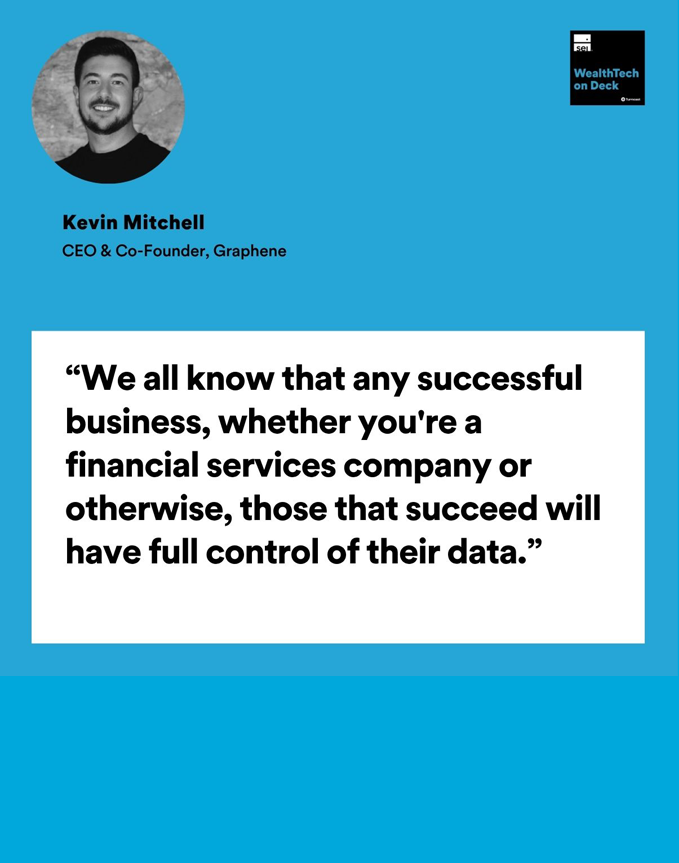
“We all know that any successful business, whether you’re a financial services company or otherwise, those that succeed will have full control of their data.”
Read the full transcript
Jack Sharry: Hello, everyone, and welcome to this week’s edition of WealthTech on Deck. Today’s conversation sits at the intersection of wealth management, technology, infrastructure, data, and enterprise value. Our guest is Kevin Mitchell. Kevin is the CEO and co-founder of Graphene, a U.K.-based wealth technology firm that helps firms take greater control of their platforms, data, and value chains. Founded in 2021 by Kevin and fintech investor Robert Kelly, Graphene was created to address a structural challenge. Many firms manage significant client assets but lack the resources to build and operate modern platform infrastructure themselves. Graphene’s thesis is simple and provocative: Most wealth firms don’t truly own their platforms. By relying on outside providers, firms often give up control over the data, client experience, economics, and long-term enterprise value that shape their future. Graphene offers another path. Its infrastructure-as-a-service model helps firms regain control without having to build everything from scratch. Today, we’ll explore whether wealth management is entering a new era in which strategic control over technology and infrastructure is moving back in-house. Kevin is at the center of that conversation, and I’m looking forward to hearing his perspective. Kevin, welcome to WealthTech on Deck. It’s great to have you here.
Kevin Mitchell: Thanks, Jack. I’m genuinely happy to be here. Thanks for having me.
Jack Sharry: Why don’t you start by giving us some background? How did you get started in all of this? Tell us about the career journey that led to the launch of Graphene, the opportunities you saw at the time, and what you’re doing about them today.
Kevin Mitchell: Sure. Thank you. Unlike most people, I don’t particularly enjoy talking about myself, Jack. But my background is very much in building and operating regulated platform technology. For nearly 17 years, I’ve worked in the custody and administration sector here in the U.K. and Europe. The glamorous way of describing it is that I’ve spent my entire career working in the parts of wealth management that no one puts in the brochure: custody, settlements, data, operations, and all the plumbing. During the latter part of the 10 years before Rob and I established the business, I began to see a contradiction. We were working with some phenomenal wealth management firms led by brilliant people. In some cases, they managed billions of dollars in assets. Yet many of these firms didn’t necessarily have the expertise, resources, budget, or, in some cases, the desire to build and own the infrastructure on which their entire businesses operated. As I’m sure you and your listeners know, many firms patch together and rent several different systems from providers whose interests aren’t necessarily aligned with those of the wealth management company. The opportunity we identified was clear. Many of the companies we worked with were handing their data, client experience, and the economics of being a platform operator over to third parties. We decided to create an infrastructure platform that would give wealth management firms access to world-class institutional custody capabilities. We also wanted to provide technology that wasn’t simply another layer sitting on top of systems that weren’t as interoperable as they needed to be.
Jack Sharry: Let’s talk about a phenomenon I call convergence. Many different capabilities are coming together. If I understand you correctly, you’ve built the outline of an infrastructure, or a superstructure, for putting all these pieces together. I’m assuming that includes both outsourced and in-house capabilities, but with the operator or wealth manager maintaining much more control over the infrastructure. Am I understanding that correctly?
Kevin Mitchell: That’s absolutely right. The analogy I use, which my marketing team loves, is that we’re effectively building Shopify for wealth management. You wouldn’t necessarily expect Gymshark and a luxury skincare brand to operate on exactly the same institutional rails, right? What we’ve done is democratize access to core custody capabilities on the back end. We work closely with SEI, which I know you’re familiar with. We then provide the additional capabilities, technology, and support that allow firms to launch and operate their own regulated, front-to-back wealth platforms. That includes everything from onboarding, the client portal, and advisor tools through trading and custody.
Jack Sharry: If I understand you correctly, you can work with a variety of providers. It’s a matter of having the capability and connecting the different pieces.
Kevin Mitchell: First and foremost, yes. Over the last 24 months, however, we’ve started building more of our technology in-house to give us greater control over how the platform is deployed within each firm. The best way to view us today is as a regulated estate containing multiple platforms. We work with private banks, multifamily offices, top-100 national adviser firms here in the U.K., and, in some cases, single-family offices as well.
Jack Sharry: You’re making things easier at the infrastructure level so that more capabilities can be connected and coordinated as the industry continues to converge. Is that fair to say?
Kevin Mitchell: Yes. We all know that operating regulated businesses is becoming more difficult. There isn’t going to be less regulation, as much as we might love that to be the case. Competition is increasing as well. The democratization of technology through AI, combined with the efforts of many firms to build something truly differentiated, has created a perfect storm and a significant opportunity for us. If we can bring everything into one place and become a trusted partner with genuine skin in the game, that creates a powerful relationship. Every transaction that flows through our regulated environment and every asset held within the custody pools involves us. As a result, we develop truly strategic relationships with our clients. We don’t work only with advisors or operational teams. In many cases, we also work with the C-suite and shareholders. When a firm wants to optimize its internal operations, whether by reducing risk or gaining process efficiencies, we can help. By becoming a platform operator, a firm can also turn that capability into part of its service offering. There can be a significant compounding return from taking control of that part of the value chain. Rather than handing clients, whom the firm has spent years acquiring and building relationships with, to a third-party platform, the wealth manager can bring those clients into its own environment. In many cases, costs come down because the firm gains efficiencies by placing clients within a more consistent model. It can then use the resulting revenue and free cash flow to reinvest in its clients and business.
Jack Sharry: Describe Graphene for our audience. Many of our listeners may not be closely following developments in the U.K., but it sounds as if you’ve built a system that could be exported elsewhere. I’d like to hear about that. Essentially, you’re creating a more efficient operating system, regardless of the mix of capabilities a custodian or wealth manager may have. Tell us more about the role Graphene plays. What do you do? What do you enable? What are the benefits for the user, buyer, or owner?
Kevin Mitchell: For us, it begins with understanding where the wealth manager wants to go. Many of the wealth managers we work with are sick to the back teeth of dealing with third parties that can’t align with their preferred processes or the way they want to operate. Taking control of the platform addresses that problem. I recognize that the word “platform” means different things to different people. To us, a wealth management platform encompasses everything from custody through the client portal experience. That includes onboarding, client reporting, portfolio management, trading, administration, suitability reporting, and all the tools an advisor needs. Graphene has created an estate that can support multiple platforms. That means multiple wealth managers can operate distinct platform propositions within one environment that we help them launch. This allows wealth managers to reduce internal costs and risk. Most importantly, it enables them to generate revenue from the assets on their platforms.
Jack Sharry: Let me see whether I can put all this together. You’re addressing risk, the efficient flow of information, and the movement of data. I’m assuming taxes may also be involved, and I’d like to hear about that. You’re connecting many different dots to create a more efficient system. The specific components of the system don’t necessarily matter to you. Your objective is to help wealth management firms give their clients a better experience. You want information to flow more efficiently, effectively, and accurately, ultimately improving outcomes for everyone in the value chain. I’m not sure whether I stated that clearly, but is that a fair description?
Kevin Mitchell: Yes. We’re effectively a one-stop shop. Consider how a client begins working with Graphene. We have our own proprietary data platform. Any successful business, whether it’s a financial services company or something else, will need full control of its data over the coming decades. We provide every wealth manager that works with Graphene with its own data lake within our environment. The firm has full sovereignty over that data. It can access and control the data however it chooses. That enables us to automate and integrate processes easily, not only within wealth management but also across ancillary areas such as finance, compliance, and even marketing. Alongside the data platform, the second pillar is our regulated wealth platform offering. That includes custody, administration, portfolio management tools, the client portal, the advisor portal, and the other tools the firm needs. Combined with our internal operational services, we become the back end and middle office for many of our wealth management and independent financial adviser clients. Our ideal customer can focus on managing clients, ensuring that its investment proposition is suitable, and building a successful wealth management business. What we bring to the table is centralization and the ability to build and scale the business from within, rather than depending on third parties that may have different agendas.
Jack Sharry: Where do you see this going? You’re creating a more seamless experience and a more seamless operation, so I’m curious where you take it from here.
Kevin Mitchell: Do you mean the business or the proposition?
Jack Sharry: Either one. All of the above.
Kevin Mitchell: That’s a great question. From a proposition perspective, we understand where we sit in the market. We’re at the convergence of data, technology, and regulated platform services. We’re bringing those capabilities together, and we want to do more of that. We know where we need to go. From a business perspective, since receiving our FCA authorization 18 months ago, we’ve grown from approximately $100 million in assets to well over $6 billion. We’re one of the fastest-growing platform businesses here in Europe. We built and incubated the business within the U.K., which is a very mature marketplace. We now have cornerstone clients in the Channel Islands and Switzerland, and we’re looking farther afield. To answer your question, our ambition is to build a global company and introduce the industry to a new way of thinking about wealth management platforms.
Jack Sharry: One of the subjects we discuss frequently on WealthTech on Deck is convergence and the idea of bringing everything together. As I’ve said and advocated for decades, improving outcomes requires addressing costs, risk, and taxes. In the United States, Social Security is another consideration, and I believe you have a version of that in the U.K. Ultimately, people invest because they want to have more money. That’s the objective. Tell us more about convergence. It seems to me that Graphene is well-positioned to play an important role in bringing these capabilities together.
Kevin Mitchell: The entire reason we’re here is to serve the end customer. One of the major pillars of our thesis is that we won’t build something unless we believe we can be the best in the world at it. Instead, we want to unlock and democratize institutional capabilities for wealth managers that don’t necessarily have tens of millions of dollars to invest in building their own platforms. We began by surveying the marketplace to identify the institutional partners we considered to be the best. One of those partners is SEI. SEI is a global custodian with a strong track record in multi-asset-class, multijurisdictional custody. It can support everything from a relatively simple equity listed on the London Stock Exchange to a sophisticated private hedge fund. We wanted to ensure that wealth managers in our target markets could access those capabilities. That allows them to build better propositions for their customers. It also gives them confidence when moving assets onto their own platforms because they’re working with a truly robust counterparty on the back end. One thing I regularly say to clients and prospects is, “If I wouldn’t put my own money on this infrastructure, or my mother’s or father’s money, why would I ask you to?” We take the selection of counterparties very seriously. SEI also provides tools related to areas such as tax and portfolio management. Those are capabilities we don’t necessarily need to build ourselves. Tapping into those capabilities and providing access to them through our suite of modules and tools has been a major unlock for us.
Jack Sharry: As I’ve been known to say, no podcast is complete without a discussion of AI. I have to believe AI is an important part of what you’re doing because you work with a variety of systems, vendors, and custodians. You’ve mentioned SEI. I’m assuming it’s one of several providers you work with. Where does AI fit into all of this, and how are you deploying it?
Kevin Mitchell: As a business, we take a somewhat contrarian view of artificial intelligence. We understand that AI has changed the world. By God, it has changed our internal operations. But when you think about any good company, it needs a strong foundation. If you don’t have that foundation, both from a data perspective and in how you take customers and invest their assets in the market, you have a problem. Whether a firm uses a third-party platform or operates its own, the foundations and the bricks of the house need to be stable. If they aren’t, overlaying AI will simply create more problems. We’re encouraging clients to take a five-year view because no one knows exactly where we’ll be by then. Internally, we’re certainly using AI. We also have our proprietary data platform. When working with clients to help them absorb AI as a feature of their infrastructure, we focus on several questions: How can we interrogate the data? How can we generate insights? How can we bring more information from third-party sources into one secure location? Security has to come first. These are regulated businesses run by regulated people, and in many cases, individuals carry personal liability. Internationally, we’re seeing significant hype around AI, along with some short-term successes. Many AI companies have been able to layer technology onto existing systems and create efficiencies. But there is always a cost-benefit and operational analysis. How long does a fact-find take the customer? Perhaps AI reduces it from five minutes to two. Cash-flow and reporting analytics might go from 30 minutes to 10. But if the data isn’t held in a secure environment, if you don’t know who the counterparties are or where they store the data, and if those providers don’t understand the compliance restrictions and regulatory environment to the necessary degree, you can find yourself in a very difficult position. My counsel to most people is to take a step back, solve for the foundation now, and build on it safely and incrementally over time.
Jack Sharry: That’s interesting. One reason I have this conversation about AI on nearly every podcast is that I’m trying to understand it myself. I’ll give you my layman’s view. What you’ve described is the use of AI at the infrastructure level. People like me might use AI tactically. For this podcast, I use it to help determine what to ask you about and understand what you’re focused on. That’s the relatively simple, high-level stuff I do. It may help me ask better questions and obtain better information, which is valuable. But making a fundamental difference requires inserting or incorporating AI at the infrastructure level. That can reduce processing times and become part of the platform’s fundamental value proposition by helping everything work better. Am I translating what you’ve said into layman’s terms reasonably well?
Kevin Mitchell: Yes, 100%. A great case study involves a phenomenal RIA business we work with. We provide its data platform and wealth management proposition, through which it invests client assets daily. The firm also works with a CRM provider and spends a couple hundred thousand dollars a year on that system. The CRM wasn’t doing what the firm needed. It wasn’t perfect, and the team constantly relied on workarounds and spreadsheets to obtain the management information and reporting it required. The firm approached our customer success team and said, “You’re our technology partner. Can you help us?” Over the last nine months, we’ve placed forward-deployed engineers within the business to build a custom application. In many cases, we created the proof of concept using tools such as Claude Code and Cursor. During the testing period, we brought the application into the firm’s environment and infrastructure. The firm now has a custom application that has displaced a significant amount of cost while doing a better job for the internal team. That ultimately produces a better outcome for clients. When we talk about using AI at the infrastructure level, we’re talking partly about processes. But we’re also talking about the ability to work more closely with clients and build technology safely. I believe most financial services companies need to recognize that opportunity now. They need the right infrastructure to ensure that, five years from now, their clients are fully integrated across the business.
Jack Sharry: Let’s talk about where you see the world going over the next several years. Change seems incredibly rapid now. Over the next five years or more, where do you think we’re headed? What are some of the more important developments we should be aware of and thinking about?
Kevin Mitchell: From a business perspective, what excites me most is that I believe we’re at a tipping point. Having control of your infrastructure is moving from something people view as brave, as in, “That wealth management company has its own platform and controls its data,” to something that simply seems obvious. We hope we’re well-positioned to be part of that exciting story for many companies. One reason I launched Graphene, beyond seeing the opportunity to help firms bring their platforms in-house, was that I enjoyed working with entrepreneurs and helping people build their businesses. For me, I’m now in the perfect environment. We have a great product that I can introduce to the sector, but Graphene is also a vehicle that allows me to work closely with firms and help them tell their stories differently.
Jack Sharry: I love it. This has been a lot of fun, and I’ve really enjoyed the conversation. Let’s shift gears from infrastructure, data, and the other complicated issues we’ve discussed and talk about you for a moment. What do you do for fun outside work when you’re not dealing with all these weighty and complex matters? What do you do to recharge?
Kevin Mitchell: When I have five minutes to myself, it’s mostly about family. They’re wonderfully unimpressed by anything I’ve just said on this podcast, which is exactly what I need while running a startup and building a business from zero assets to more than $6 billion, with some wonderful clients and great institutional shareholders. I find it genuinely therapeutic to have a family that looks at me simply as a human being. I spend as much time as possible with Fiona, my wonderful wife, and my two-year-old son, William. That’s mainly what I do. Occasionally, I get the opportunity to play golf, although at the moment that may happen only once every three or four months. If I’m not with my family, you may find me on the golf course.
Jack Sharry: Got it. For members of our audience wondering where you’re joining us from, you’re in Edinburgh as we speak, correct?
Kevin Mitchell: Yes, I’m in central Edinburgh. I was born and raised in Fife. If any golfers are listening, I live about 25 minutes from St. Andrews.
Jack Sharry: That’s very cool. I imagine a few listeners are jealous. Kevin, this has been great. I’ve really enjoyed our conversation. Thank you for sharing your perspective on technology, infrastructure, data ownership, and where wealth management is headed. It has been great having you join us. To our audience, thank you for tuning in. If you enjoyed our podcast, and today’s episode in particular, please rate, review, subscribe, and share WealthTech on Deck. You can find us at wealthtechondeck.com. Kevin, thanks again. This has been a lot of fun.
Kevin Mitchell: Thanks, Jack. That was fun.