Putting Purpose Before the Plan with Lance Gunkel
This week, Jack Sharry talks with Lance Gunkel, Managing Director at Syverson Strege. A CFA charterholder and CFP professional, Lance joined the firm in 2003 and has spent more than two decades helping clients connect their financial decisions with family, generosity, and community impact.
Jack and Lance explore what Lance calls the social legacy, the dimension most planning conversations miss once retirement income and inheritance are addressed. Lance discusses Syverson Strege’s approach to personal, family, and social legacy, the questions advisors can use to uncover what clients value, and explains why purpose has to come before the plan. They discuss integrating charitable giving with investment, tax, and estate decisions, and why involving the next generation early helps avoid surprises. Lance also unpacks the firm’s Educate to Give program, which helps nonprofits educate their top donors on advanced giving strategies, and shares why treating nonprofits as long-term partners has helped the firm grow with the clients it most wants to serve.
What Lance has to say
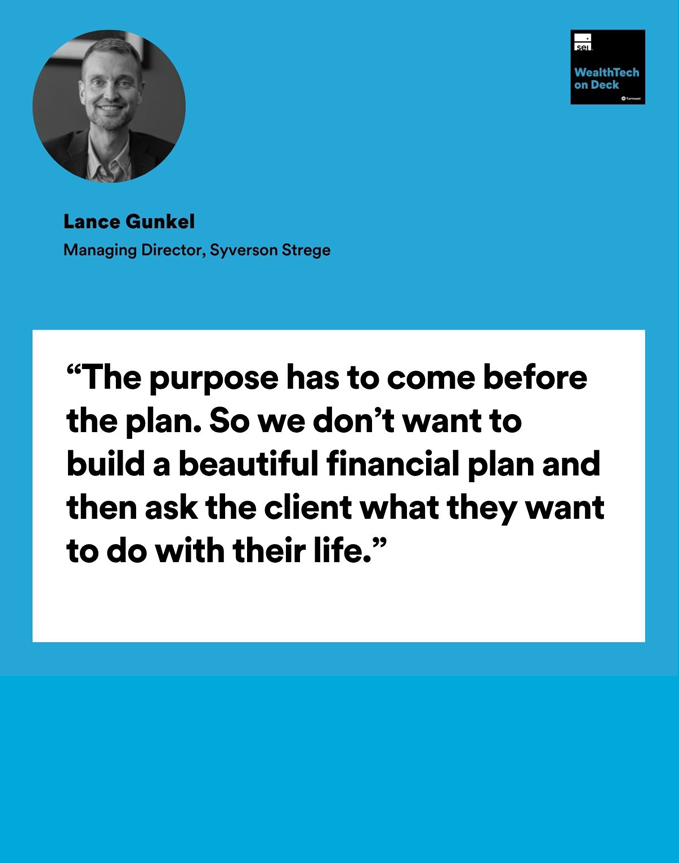
“The purpose has to come before the plan. So we don’t want to build a beautiful financial plan and then ask the client what they want to do with their life.”
Read the full transcript
Jack Sharry: Hello, everyone, and welcome to this week’s edition of WealthTech on Deck. In wealth management, we spend a great deal of time talking about strategy, the future of financial advice, how investments and technology work together, and a whole lot more. But eventually, every investor faces a more fundamental question: What is all this money actually for? My guest today has built a career around helping clients answer that question. I know a lot of you who are listening have spent a lot of time thinking about that along the way, but he has an interesting approach. Lance Gunkel is a managing director and shareholder at Severson Strege, a fee-only wealth management firm based in West Des Moines, Iowa. He’s a CFA and CFP professional. Lance Gunkel has been with the firm since 2003. He oversees the firm’s financial client service, staffing, and reporting processes, contributes to its growth and development, and serves on its investment committee. What particularly interests me is Lance Gunkel’s focus on helping clients identify their “why” and how they connect financial decisions with family, experiences, generosity, and community impact. His work also extends into charitable planning and relationships with nonprofit organizations. I’m particularly interested in how that works. Today, we’ll explore Lance Gunkel’s journey, his approach to advice, the role of purpose in philanthropy and financial planning, and what advisors can learn from working both with and alongside nonprofit organizations. Lance, welcome to WealthTech on Deck. Great to have you here.
Lance Gunkel: Yeah, Jack, thanks for having me.
Jack Sharry: So, let’s start with your story. How did you find your way into wealth management, and what has kept you at Severson Strege for more than two decades?
Lance Gunkel: My first interest in the field was sparked by my dad. I was a teenager, and my dad was just trying to find any way possible to stay connected with me. He helped me see how savings and investments could grow wealth. We sat down with his Kiplinger magazines at the time, and we would do our rudimentary research. This was back when you had to write checks and send them to the mutual fund companies. I loved writing those checks. I loved receiving those quarterly statements and seeing how I did. This was the mid- to late 1990s, so you really couldn’t go wrong. I thought I was a genius.
Jack Sharry: Sure, easy peasy.
Lance Gunkel: That’s what sparked my curiosity. So, I studied finance at Drake, which led to an internship here at Severson Strege. I got to know the business really from kind of the ground floor. I had a short foray into business valuation after college, but I found my way back to Severson Strege as an analyst and never looked back.
Jack Sharry: That’s great. So, you had a taste of what the spreadsheets looked like, and it sounds like you wanted to use them for good in terms of working with clients. Let’s talk a little about helping clients find their “why” and, frankly, the unique approach, as I understand it, that you use to do that. One of your central messages is that people should know their “why.” Why are they saving, investing, giving, or building wealth in the first place? How do you help clients get below the numbers and discover what their money is really meant to accomplish?
Lance Gunkel: We find that most of our clients, when they first come to us, have talked with their prior professionals only about what we would call their personal legacy and their family legacy. Essentially, that is: Do I have enough to live on during retirement? Then, how much can I pass along to my heirs? In reality, we find that clients really want so much more out of their resources. The missing piece is what we call the social legacy. It’s how clients can use their resources to help their communities and the charities that are important to them. We simply ask the question, “Other than family, who else do you want to help?” We get clients thinking about becoming philanthropists. When we bring that term up, it’s like their eyes light up. They’ve never thought of themselves that way, but when they realize that this is a possibility for them and, yes, they can do it, it’s quite exciting to be part of that journey.
Jack Sharry: So, I’m going to guess that you’ve probably developed a pretty strong reputation. I know you also work with a lot of nonprofits and other recipients of philanthropy, so you’ve got to have a pretty good reputation. You’re probably starting at a better spot. Talk a little bit about that dynamic. How did you come to this? How did you get connected? How did this come about? I’ve been around this industry a very long time, and I haven’t heard it play out as well as I understand it has in your practice. It has really developed into something pretty phenomenal, I think.
Lance Gunkel: Yeah, I have to give all the credit to one of our co-founders, John Severson. John Severson has been in this industry since the 1970s, and from day one, he felt that philanthropy should be at the heart of financial planning. He immersed himself in that community. He rubbed elbows. He was wherever all the nonprofits were, and he got to know their boards of directors and their fundraisers. He was just there learning about the nonprofit world and really not trying to seek out anything for himself or the firm, but just to learn about what they needed. He brought to the company a strong belief that healthy and happy communities are built by healthy and happy nonprofits or charities. He also believed that the types of people we like to work with and want to work with more are the same types of people nonprofits are looking for as donors, and that we could really be partners with these nonprofits. So, that’s how it started. It was just getting involved in the community and finding nonprofits that wanted to partner together.
Jack Sharry: Talk a little bit about that. We’ll get into that push and pull of both helping them and benefiting from the relationships you create with them. We’ll talk about that in a little bit. But talk about how you get started. How do you get to know these nonprofits and organizations? What’s your role as you go in? Then, once you’re talking with clients or potential clients, how does that play out? I’m just curious about how this occurs and how it evolves.
Lance Gunkel: Yeah, we have local organizations that are really monthly get-togethers of nonprofit organizations, and we just ask if we can join those and get to know the members better. Oftentimes, we’re the only financial planners in the room. It’s probably not common for us to be there. So, I would say that is one way. We also offer free educational sessions for nonprofits. We allow them to invite their boards of directors, fundraisers, executive directors, or anyone who wants to learn a little bit more about advanced giving techniques. Now, we don’t expect them to become experts at advanced giving, and they probably shouldn’t. But we want them to be able to be conversant in this language so they can have deeper and richer conversations with their donors. Getting them into our office for these educational sessions really positions us well as kind of a thought leader in this space. When they are meeting with a donor whom they think might have more to give, they can send them in our direction for some additional conversations.
Jack Sharry: Interesting. Let me back up, or maybe move forward a little bit. You’re meeting with someone, and you mentioned that, early on as part of the initial conversation, you want to understand their desires, hopes, and dreams around philanthropy. Talk about that. How does it go? What does it lead to? Talk about the dynamic and quality of that conversation.
Lance Gunkel: Opening up a client to this conversation differs based on personality, but we can find our way there through a series of questions. We ask: Was there a person, maybe a coach, mentor, or group, who helped you when you were growing up? Who was instrumental in shaping your career? Has there been anyone who helped you and your family in times of need? What core values do you want to pass down to your family? What life events have shaped your family? These aren’t questions that are typically asked by a financial planner. They may not know what we’re getting at at the time. We’re just learning more about them with no ulterior motive. But just by listening to them, we might be able to pull out areas of interest or groups that they might want to support in a greater way, or in a way they’ve never thought about before. They also start to view us differently. We are not salespeople here at Severson Strege. We would make very poor salespeople. We enjoy learning about these families and really thinking creatively about how we can help them. When we find areas or groups they’re passionate about, we love to find ways they can help those groups in an even greater way.
Jack Sharry: Interesting. Do you frame it up or at least position the conversation as an area of expertise or interest? Do you frame it, or is it just part of your natural dialogue?
Lance Gunkel: Yeah, we just call it our discovery phase. We leave it as open-ended as that. Some clients are quite comfortable having this conversation right off the bat, face to face. But with others, it’s clear that they’re maybe not as comfortable, or maybe they haven’t even had these conversations with their spouse. In those instances, we have a workbook they can go through either together as a couple or independently. That may jostle something within them and might be easier to share when written down on paper as opposed to face to face.
Jack Sharry: I’m curious about the dynamic. You’re having this discovery-process conversation, and it’s unusual relative to conversations they’ve probably had with other financial professionals. I’m imagining there’s a shift at a certain point where they go, “These guys are different.” I’m guessing that’s what happens. Others may be just trying to beat the S&P, and I’m sure there’s inevitably some conversation around performance and all the rest. But it seems like it’s more about what matters to the clients. Am I getting that right?
Lance Gunkel: Yeah, it’s all about what matters to them. You mentioned earlier knowing your “why.” Our “why” here at Severson Strege, which we framed a long time ago, is that we exist to enrich and empower lives. We believe that holds true within the firm. We want to enrich the lives of those people we work with, but also our clients and our communities. In order to do that, we really do need to get to know the client. It goes beyond recommending a certain investment strategy. Now, if someone comes in and has a hot-button issue that needs to be solved quickly, we certainly do that. But apart from that, we want to take our time getting to know them before we put strategies or strategic recommendations in place.
Jack Sharry: You know, it’s interesting. Some of our listeners have heard before that I teach a course in persuasion at Babson College. Part of that is to listen for what really matters to the person you’re trying to persuade. What really counts? What is their life about? What is their “why,” really? I haven’t framed it that way, but that’s essentially what I’m asking. If you listen well and understand what really matters to someone, my experience is that the trust factor goes way up. The willingness to share their perspective opens up. Talk about that dynamic. My guess, and I’m pretty confident in this guess, is that they really open up and there’s a higher level of trust. They’re more forthcoming. Frankly, I would imagine they’re more forthcoming with assets as well. But fill us in on that.
Lance Gunkel: Yeah, you’re absolutely right. When they realize that we are willing to just sit and listen, people love to talk about themselves.
Jack Sharry: They love to talk about their favorite subject.
Lance Gunkel: Yeah. They like to talk about how they got to where they are today, what they’re passionate about, what they love, and what they want to do. They realize we’re not sitting down with a notepad, asking for their five goals, and writing down those five goals. We want more of their story. We want to know what got them to where they are. We coach our planning staff that, in those discovery meetings, we should be talking about 20% of the time and listening 80% of the time.
Jack Sharry: Yes.
Lance Gunkel: Now, that was always a rough rule of thumb. One of the beauties of AI is that we can now record our meetings and see how true we are holding to that.
Jack Sharry: Sure. I would imagine it also helps distill what really matters to them. AI does a nice job of that sort of stuff. Is that part of it, too?
Lance Gunkel: It does, absolutely.
Jack Sharry: So, how do you guys translate this purpose-driven philosophy into actual planning, from what matters to clients to starting to put it into a household portfolio and all the rest? How does that transition go?
Lance Gunkel: Well, maybe the easiest way to explain it is that the purpose has to come before the plan. We don’t want to build a beautiful financial plan and then ask the client what they want to do with their life. We want to understand what they’re trying to accomplish first and then use financial planning as the tool to help them get there. So, when we’re talking about investments, taxes, retirement, or charitable giving, we’re constantly asking, “What are we trying to accomplish for this family?” The technical recommendation is important, but it’s not the end goal. It’s just the means to an end. If a client tells us they want to retire early, help their children, or give significantly to charity, we don’t view those as three separate conversations. We think those things have to fit together into one cohesive plan. I think that’s what makes the plan itself purpose-driven.
Jack Sharry: I love this. You say you’re not salespeople, but, of course, I use the term persuasion when someone is artful about how they have these conversations. I would say you guys are very persuasive. I’ll withdraw the salesperson moniker. Let’s talk a little bit about charitable giving. It can sometimes be treated as a specialized conversation that takes place toward the end of the planning process. It sounds like what you’re doing is making it integral. As you mentioned, there may be different philosophies, goals, or objectives. Talk about how you synthesize all that. I imagine it plays out in how you might wind up making recommendations as far as investments and the rest.
Lance Gunkel: Yeah, similar to my prior comments, I think philanthropy belongs in the plan right alongside retirement, investments, tax planning, and everything else. For some clients, charitable giving is a relatively small part of their financial picture. But for others, it’s one of the primary reasons for accumulating wealth in the first place. We have many clients who are giving away their entire worth to charity, and it’s incredible to be part of that. If it’s important to the client, it needs to be part of the plan from the beginning. It can also influence how we structure investments, when we realize capital gains, how we approach estate planning, and even how we involve the next generation. If philanthropy is a big piece, the next generation should know that. We want to pass down some of those philanthropic values to the next generation, but we also don’t want them mistakenly thinking they’re receiving everything from Mom and Dad when that’s not part of the game plan.
Jack Sharry: Sure. Talk about that dynamic. I’m assuming that involving the family happens earlier. I would assume that not only are there teachable moments involved, as I hear it, but it also sets up expectations around any inheritance or what have you. Talk about that whole dynamic.
Lance Gunkel: Yeah, many clients will ask us when they should involve their children or adult children in that conversation. Our answer is anytime they think their children are ready. I don’t know if it’s ever too soon. If they’re younger, and always at the option of the client, we will hold a family meeting with all generations. Sometimes, we strip out the numbers so they don’t see how big the dollar amounts are. We’ll let Mom and Dad start by sharing what we might label their family financial philosophy and how they’re thinking about inheritance and charitable giving, maybe from a higher level. That’s where we can come in and explain the estate distribution plan to the next generation and how charity is involved as a component of that. We find that, for some adult children, they expected this from Mom and Dad. They knew that would be a big part of the plan. For others, it’s complete news to them. But we tell our clients that we believe it’s better for their children to know in advance and not find out at the end, when the parents are no longer around.
Jack Sharry: That would seem to make sense, although it could be a little tricky, I imagine. Let’s talk about an interesting dimension of all this. Your work involves nonprofit organizations. Help us understand how that is part of your practice because you not only work with individual clients, but you’re working with the nonprofits themselves. Talk about that dynamic, how it works, and fill us in on that.
Lance Gunkel: Yeah, I think our biggest partnership with nonprofits is through a program we run called Educate to Give. We charge the charity a nominal amount so that they have some skin in the game. We ask the charity to gather its top 10 donors for an educational session that we deliver. We ask the nonprofit to find someone it would consider a champion of that nonprofit and have that person act as the host. We have found through experience that this creates a friendlier, homier atmosphere for the session, as opposed to coming into our office, where it feels maybe more lecture-like. We’ll have food, hors d’oeuvres, and maybe some wine. We keep it fairly casual. But this is our chance to share, at a high level, some advanced charitable strategies with which most donors are unfamiliar. We find that this really opens their eyes to additional possibilities for helping their favorite charities. The charity can position this as a free gift to them for being one of its top donors, just some additional information they may find valuable. We offer a free consultation with everyone who attends. We’ll review their situation, review how they’re currently giving to charity, and provide them with some feedback. The cost for this is covered in the fee we charge the charity. If the donor wants to dig a little bit deeper and get more specific about their situation, and if they don’t work with an advisor, that’s where we can come in and talk about them possibly engaging with us. But during the Educate to Give sessions, there’s no direct talk about giving to that charity unless the donor brings it up. There’s also no promise that we will end up having charitable dollars sent the way of the charity because we can’t make that promise. But we can arm donors with the tools necessary to give away more money. In our eyes, this maybe takes a long-term mindset, but the ultimate goal is to spark meaningful legacy and planned-giving conversations. This should assist organizations in building and funding stable endowments down the road.
Jack Sharry: Help me understand, and help our audience understand, some distinctions here. In some cases, you’re marketing to a nonprofit as a prospective client. You’re marketing through a nonprofit to reach donors. And you’re marketing with a nonprofit around shared educational values and community impact. Make those distinctions because it sounds like you balance them well, but I’m sure there are certain dynamics you need to have in mind as you pursue this kind of approach.
Lance Gunkel: I think earlier I referred to our view of nonprofits as partners, and we really do view them that way. We don’t think of this as necessarily marketing to or through nonprofits. We want to be partners with them. We want to be in front of the same donors or philanthropists that they do. We think it’s kind of a team approach. Hopefully, that got to your question. I’m not sure if I hit the mark there.
Jack Sharry: No, I get it. It’s delicate. It sounds like you’re pulling it off masterfully, so it seems to be working. As I understand it, when we spoke earlier, you mentioned that your firm is experiencing a much higher growth rate. I think the industry is at a 2% or 3% organic growth rate, and I think you guys are at a multiple of that. It seems to be playing out well. It sounds like you have just the right touch, balance, and feel for this sort of thing. Talk about how this has affected your business because I understand your business is growing nicely.
Lance Gunkel: Yeah, well, this program has certainly helped us grow. In our minds, it has helped us grow by allowing us to work with the types of clients we really want to serve. When we put together our strategic plan, which is something we review every year, we reexamine our target market and whom it is that we really want to work with. We believe it’s willing and giving stewards. They’re the same people nonprofit organizations want to be in front of. We believe that by serving this market, we may pay a little bit less attention to the speed of our growth. But we think that, in the long run, we’ll get the right types of clients from these activities. That has played out well. We don’t have specific goals for each educational session we hold. But on average, we probably get a couple of opportunity meetings from every educational session, and maybe one of those becomes a client. The people we’re getting in front of tend to have substantial wealth. So, these are really great people whom we want to work alongside.
Jack Sharry: It seems purposeful and purpose-driven, for sure. It also seems very effective. You’re talking to the right people who have money, questions, and a desire to be smart about how they distribute it over time, just as they have been smart in their careers, businesses, and lives. I imagine that’s all part of the equation, where essentially there is a like-mindedness between how you guys operate and how they want to be treated. Is that fair to say?
Lance Gunkel: It is fair to say, yeah. I would caution people against thinking that this results in quick growth. It takes years to plant the seeds and gain the trust of the nonprofits. They really have to trust us to put us in front of their top 10 donors, and that does take time.
Jack Sharry: It sounds like you guys are doing the right things in the right way. Yes, long-term success takes a long time, but it sounds like you’re doing it very well. So, Lance Gunkel, before we wrap up, we always like to end on the human side of things as we talk to advisors and executives in our industry. I know you’ve completed a 100-mile trail race. You’ve traversed the Grand Canyon from the South Rim to the North Rim and back in a single day. Oh, my God. What attracts you to these endurance challenges that you’ve taken on and apparently have done so well?
Lance Gunkel: As luck would have it, my wife lets me do one of these long runs per year.
Jack Sharry: Okay.
Lance Gunkel: That’s all I’m allotted. I finished one this past Saturday in western Illinois.
Jack Sharry: Okay.
Lance Gunkel: It was 100 miles along the Hennepin Canal. I think what attracts me is just the ability to learn that I can make it through challenging situations. In a 100-mile run, which may take me about 24 hours, I encounter a lot of hurdles. Maybe my stomach stops cooperating and I can’t eat anything. But I have to get calories in if I want to keep going. Maybe my Achilles starts screaming at me. So, I have to troubleshoot, in the moment, all these issues that come up. Then, there are the mental and emotional ups and downs throughout a day of running. It has come to the point where I now look forward to those moments. I call them “moments of suck.” I’ve learned to embrace them because I want to prove to myself that I can make it through. If I just keep going one more step at a time and make it through this problem, I’ll get through it.
Jack Sharry: That’s crazy. Another interesting fact we were able to dig up is that you’re a published poet. So, do tell. Where does that fit into the whole scheme of things? You take a very interesting approach to life, it seems to me. Tell me more.
Lance Gunkel: Well, the published poet thing is a little bit of an inside joke, a little bit tongue-in-cheek. When I was in fifth grade, I was quite into the Boston Celtics basketball team. This was the Larry Bird era. For my poem, I wrote about the starting lineup of the Boston Celtics. My teacher submitted it to our local newspaper, and by golly, it made it in. So, technically, I’m a published poet.
Jack Sharry: I get it. Our research only went so far, but that is such a Midwestern story, by the way. I love it. As a Bostonian, I have also been a lifelong Celtics fan. So, it’s good to know we’re on the same team there as well. Lance Gunkel, this has been great. I’ve really enjoyed this conversation. It’s one of the more interesting conversations we’ve had among the 250 or so episodes we’ve done over the past five years. Thank you for sharing your experience and perspective. My key takeaway is that great advice begins with helping people understand what their wealth is for. When advisors connect financial planning to purpose, family, generosity, and community, they can do much more than improve a portfolio. They can help clients use their resources to create meaningful impact, something I’m quite fond of doing in my personal life. Your work also demonstrates that nonprofit organizations can be much more than recipients of charitable gifts. They can become trusted partners in education, engagement, community building, and organic growth. Thanks for being on our program today. I really enjoyed it. To our audience, thank you for listening. If you’ve enjoyed today’s episode, please rate, review, subscribe, and share WealthTech on Deck. You can find us at wealthtechondeck.com. Lance Gunkel, thanks so much. This was really a pleasure. I really enjoyed it.
Lance Gunkel: I loved the conversation, Jack Sharry. Thank you.