Building the Bridge to a Better Retirement with David Goldman
This week, Jack Sharry talks with David Goldman, Chief Business Officer at Pontera. At Pontera, David leads strategy, partnerships, and the company’s mission to help Americans retire with greater security by giving financial advisors secure access to their clients’ held-away retirement accounts.
Jack and Dave discuss how Pontera is transforming the retirement landscape by empowering investors and their advisors to securely manage 401(k) assets. Dave discusses the firm’s public clash with Fidelity, the broader consumer-choice issues at stake, and why secure advisor access is essential for better outcomes. He also highlights Pontera’s new partnerships with major recordkeepers like John Hancock, the growing need for coordinated and tax-optimized household management, and how AI will enhance—not replace—human advice.
What David has to say
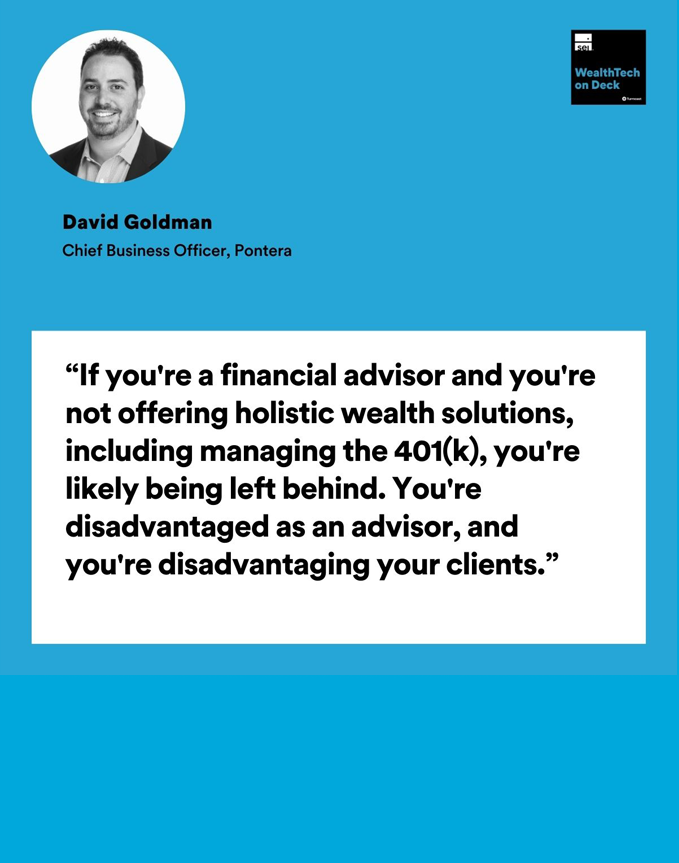
“If you’re a financial advisor and you’re not offering holistic wealth solutions, including managing the 401(k), you’re likely being left behind. You’re disadvantaged as an advisor, and you’re disadvantaging your clients.”
Read the full transcript
Jack Sharry: Hello everyone and welcome. Thank you for joining us for this week’s edition of WealthTech on Deck. As our listeners know, we love to speak with people in firms who are thinking outside the box. Today we’re going to speak with a chief business officer at Pontera. His name is Dave Goldman. Dave and his colleagues at Pontera have been thinking outside the box and shaking things up for a while now—probably as much as any firm I can think of. They’re doing some very innovative things to benefit consumers in the retirement plan space, and we’re going to talk a lot about that today. So much so, they’ve caught the attention of the biggest of them all: Fidelity. Perhaps you’ve read about it in the national press, or like me, you’ve seen it on billboards in Boston and other cities. Clearly, Pontera has not shied away from challenging Fidelity in an effort to serve consumers and advisors. Pontera’s business goal is to help individuals retire with greater wealth and financial security. They work with RIAs, broker dealers, and some of the biggest financial institutions in the country to provide a secure and seamless platform for financial advisors to manage 401k and other held away assets. Dave, welcome to WealthTech on Deck. Great to have you here.
Dave Goldman: Hey Jack, thanks so much. Really glad to be here.
Jack Sharry: Security is a big issue in our industry, and it’s led to a very public disagreement between Pontera and Fidelity. As I read about it in the press, Pontera is saying Fidelity is blocking third-party access to 401k accounts. Fidelity’s publicly stated position is that they’re trying to block competition. So, Dave, what can you tell our audience about all this? This is kind of an interesting turn of events. You don’t see this kind of thing very often.
Dave Goldman: You know, taking a step back for a second, it’s important to remember whose account this is, whose money it is, and who’s really making the decisions, right? We don’t see this as a Fidelity versus Pontera issue. We see this as a captive consumer issue where they don’t have the right, or they’re not being given the right, from a custodian. They didn’t choose to seek help in the way that they deemed as beneficial to them in their own 401k account, which for most people could be their largest account. And really that comes down to a consumer rights issue versus a technology company issue. We agree that security is critical. It’s why we invest so much in our own security. It’s why we take every possible precaution. We use every available resource to make sure that we’re finding the most secure way to connect to and facilitate service from a fiduciary advisor on these accounts—including being SOC 2 certified and having ISO 27001 certifications. If you really zoom out and think about it, we’ve gone through security diligence with thousands of advisory firms, some of the largest in the country, and some of the largest record keepers in the country. We invite them to diligence our security and want to make sure we’re investing in the right area. So, I think when you read about security in the media, it’s really a smoke screen for, “We don’t want other people helping participants.” And I don’t think that’s the right approach.
Jack Sharry: Gotcha, gotcha. So, as you well know, we’re a regulated industry, and for good reason. These are people’s retirement savings we’re talking about. If I’m characterizing your business correctly, you’re enabling the advisor to provide legitimate advice and help the 401k participant investor do the right thing.
Dave Goldman: Yeah. These are clients that already work with financial advisors outside of the plan. The DOL has guidance that a participant can ask for help from an outside advisor with no additional burden from the plan sponsor, and no permission needed by the plan sponsor. Again, these are participants asking for fiduciary help from their own trusted advisor. So the frameworks exist, and customers that have their own financial advisors want this help. So, what you see is an industry incumbent trying to prevent that help from happening and limiting consumers’ choice and harming their potential outcomes by locking them out of their own accounts. When you think about the big picture, this is really why we stood up and said something publicly—the consumers were being harmed. They were being locked out of their own accounts. They can’t monitor their accounts when Fidelity’s taking this action, and that’s really a consumer choice issue. It comes back to whose money this is and who has the ability to control this money. It’s your retirement savings that you work so hard for. It should, of course, be your choice. And if you want your fiduciary advisor to help you with these accounts, a custodian shouldn’t be able to tell you otherwise.
Jack Sharry: Gotcha. Well, I’ll be following you in the news as this unfolds. It doesn’t look like it’s nearing an end, although I’m certain one of the parties would like to see that occur. So I’ll stay away from all that. So Dave, let’s start with, having you go a little bit deeper on Pontera. What do you all do? Who do you do it for? It strikes me that what you’re doing is unique in the marketplace. So fill us in.
Dave Goldman: Great. So Pontera is a technology platform and we enable financial advisors, as you said, to securely manage their client’s 401Ks and any other held away accounts. So think about it this way. You’re a client of a wealth advisor at Morgan Stanley, as example, you have $2 million with your advisor. You have half a million dollars in your 401k, which is held elsewhere. And to you as the client, as the investor and the retirement saver that’s worked so hard, each of these dollars is worth the same, right? But likely your advisor today or before Pontera is unable to properly manage those held away assets as part of their services to you because they’re held at a record keeper that your employer chose. So off the bat, this immediately hamstrings or harms the retirement saver by having these assets siloed off. Many are either overlooked by their advisor or poorly advised on, and it puts the advisor at a disadvantage as well. So that’s what we do. That’s what our platform is designed to do. It’s to create that bridge to a better retirement by allowing these assets to become part of the holistic management of the overall wealth of the client.
Jack Sharry: So it’s always been an issue for people that save in their retirement plans, to have it managed. How do you work around that? That seems to be a stumbling block. Are you guys unique in this regard?
Dave Goldman: Yeah. Historically, there’s a few ways that advisors help with these accounts, right? The customer is the retirement saver that already works with a financial advisor, and they do so because their financial situation warrants more help or because they don’t feel comfortable or informed enough to manage it themselves. So this means not just the assets that can be moved, but all of their assets. Advisors have been helping historically in one of two ways. The first way is, “Show me your 401k statement at the end of the year, I will take a look at your options. I’ll help you allocate to one of those things.” But as we know, the outcome of that is usually nothing. The other way advisors manage these accounts is, some firms will actually take the client’s login credentials for their 401k directly. They’ll go through an audit process, claim custody, go through the hoops that the SEC requires, and the SEC allows for this, but it creates a burdensome process. Advisors don’t love doing it. They don’t like having client credentials. They’re not cybersecurity experts. They’ll manage it and they’ll do it, but they’re jumping through hoops to make it a reality for their clients.
Jack Sharry: So it so often happens when there’s lots of regulation in and around, whatever. You have to kind of work around the system. And it sounds like, I don’t want to refer to what you all do as a workaround, but you’re basically enabling the advisor to provide legitimate advice and help the participant investor do the right thing.
Dave Goldman: What we’re doing actually is taking an existing framework of how advisors were doing this before and we’re adding security barriers around it, and a tremendous amount of tracking and frameworks to make it more secure, more transparent, and to give the advisors and the firms the tools to monitor the activity properly.
Jack Sharry: Let’s take a step back a little bit. Dave, how’d you get into this? I know you have some Google in your background. So when you talk a little bit about your career journey, how you got into this, and a little bit, I, as I understand you, you and I chatted the other day. You’re also having the experience of just talking to regular folks called friends about what they go through. So talk a little bit about how you got started, how you wound up doing what you’re doing.
Dave Goldman: That’s a good question. For me personally, I’ve always been passionate about financial literacy, financial education. I’ve always been one of those people at a company. You know, if you grow up in the wealth management space, everybody’s one of those people. But when you grow up outside of that space, usually there’s a few within a company. I was at Google for a number of years. I was the guy at Google that everyone came to and asked, “What’s a GSU at Google? It’s Google’s version of an RSU and how does it work and what do I do with it? What does the exercise mean? What does the strike price mean? Can you help me explain it? What about my 401k? What do I do with my 401k?” So personally, I was always very interested and thought financial literacy and financial education is something that the country is desperately needing more of. When I was getting ready to leave Google, I was at a fundraiser, I met a VC and he said, “Take a look at the list of my portfolio companies and if there’s any of them that are interesting to you, I’m happy to make an introduction.” There was a great list, but the only one I was interested in was Pontera because I very much align with the mission. When I leave Google, I want to be doing something that I’m passionate about that’s going to impact people’s finances for the better. I got introduced to the CEO and, as he said, that was about 10 years ago now.
Jack Sharry: Well, and you mentioned the other day, we’re chatting that, tell us about your chairman. I think he has a illustrious past to fill us in.
Dave Goldman: Yeah, so our chairman has been doing a little bit of a press tour recently. He was part of the founding team. He is a co-founder and he started the navigation app Waze. He’s been great to have as a sounding board, as an advisor, as a chairman and has built multiple, multi-billion dollar companies in his career.
Jack Sharry: That’s great. I can’t help but make the observation that Waze is about how you get where you’re going. Sounds like what Pontera’s about. Same thing. Only it’s about your money and your, not only your retirement plans, but also your taxable money.
Dave Goldman: Better outcomes.
Jack Sharry: Better outcomes in traffic, better outcomes in retirement. Get where you’re going. Love it. Anyway, I was about to play marketer and help you package that, but I’ll stop. So let’s get back to the solution at hand. You’ve been at Pontera for 10 years, I think this company’s what, 12 years old?
Dave Goldman: Yeah, about 12, 13 years.
Jack Sharry: So you guys have, you’ve been through all the hard stuff that you’re connected, I think you said 16 different firms that do some kind of optimization work, single account sounds like. Talk about that journey and then where you are now and where you see things going. Kind of take us through. Clearly you seem to have a lot of momentum.
Dave Goldman: When we started, the idea came from listening to the market, right? We listened to advisors. There were two camps of advisors. Initially, there were advisors that were giving advice based on the statement, and there was a whole contingency, thousands and thousands of advisors that were logging in and trading the accounts for their clients. As much as they were willing to do it, they wanted a better solution. We said, we can take your current process and your current solution, we can make it much more secure, much more scalable, and much better. Since then, it’s been an iterative process of listening to our customers, understanding the needs, understanding the pain points, and building what they need to better serve their customers. This is what led to integrations with 16 different portfolio management systems. You need to meet the advisors where they are. You need an integrated solution. That was definitely part of the journey.
Jack Sharry: Great news in terms of what you guys are up to, doing really good work from everything I can see and hear. I also know you had a recent announcement that was pretty important, so fill us in on that.
Dave Goldman: Yeah, so we recently announced the partnership with John Hancock. I think this speaks to a 401k provider that’s really thinking about their participants and the advisors that serve them. We went through a lengthy diligence process with them and ended up in a place where we have a robust partnership that benefits the participants. The advisors that serve them, the record keepers can help keep assets in plan for longer, and everybody gets the service they want without the friction. You really see a forward-looking record keeper like John Hancock, and we announced something similar with 401Go, who’s a big up-and-coming 401k provider. When you take a step back and think about the universe and what participants really need, they need choice in how they get help. The participants that work with their own advisors should be able to, and you see a theme of other record keepers embracing this movement, knowing that they can serve a large majority of the participants in their accounts with advice. But there will always be a need for outside advisors in helping facilitate. So excited about these partnerships. We expect more to come—more record keepers that are focused on client outcomes and client benefits. We’re going to see partnerships in the future.
Jack Sharry: Terrific. Love it. Where do you see things going? What’s next? You guys have gotten where you are. You seem like you’re in a sweet spot. Well, I’ll add another statistic that I just picked up literally this week. Some research done by UL that Scott Smith, who was recently on our podcast, who has some advice and advisory for Saru. Interviewed him and he was telling me that of the people he talks to, basically people that are responsible for product management, product development, at the big name firms, as we all know, many of which you’ve mentioned. He’s talking to those folks and understanding what they’re doing, pain points, all that kind of stuff. Their finding this year was that the top issue, top challenge is tax optimization, is trying to figure out how to coordinate the multiple accounts. The typical household has anywhere from two to seven accounts—qualified, nonqualified, all the stuff we know—and that’s their biggest issue. And then they’re finding it’s hard. It’s really, as we say in Boston, pardon me, listeners, you’ve heard me say this at least a hundred times, it’s wicked hard to pull it off where you’re managing multiple accounts in a tax-efficient and risk-appropriate way. So talk a little bit about where you see the world going.
Dave Goldman: That’s the holy grail of wealth management, right? It’s being able to collectively manage the entirety of a client’s assets based on their risk profile, their preferences, their needs on a personalized basis. You need one quarterback for that. You can’t have siloed accounts with different managers and pull that off effectively. We’re part of the solution. We’re the connective tissue. We’re not solving it by ourselves. We’re solving it by enabling the management of the account and then partnering with companies that provide the advice layer or the tax advice layer, or the tax optimization layer, and that gets investors to the best possible outcome. Instead of keeping this bifurcated system where 401k advice is only coming from your 401k provider and brokerage advice is only coming from your advisor and 529 advice is only coming from somebody else, it can’t work that way in order for us to be extracting the most value possible out of these accounts. So bringing the ecosystem together, adding that connective tissue layer is definitely part of it. When you think about the 401ks as part of this, something that’s really interesting: If you go back 45 years, the 401k didn’t exist. The world is getting more complex. So 45 years ago, you think about a retirement saver, their money was going into a defined benefit plan. They didn’t have to think about it. Here’s what you’re going to get when you retire. This is the money that’s getting put away for you, and we’re handling it. In those 45 years, defined contribution plans were launched, the space ballooned to about $12 trillion in assets. Consumers are no more prepared or educated to take on the full responsibility of managing these accounts by themselves. Now you see more complex products entering the ecosystem—crypto, alternative assets, and more. Additional choices are a good thing, but a major caveat is that they likely require more professional help as more and more assets end up in these plans and more complexity ends up in these plans. You can’t just throw these things into a plan and not have professional advisors that work with the clients help allocate across them and help consider the risks and the benefits of each of these different asset classes. The general population hired an advisor for a reason—it’s either not in their wheelhouse or they don’t like to do it or they’re delegators or it’s too complex and they want a professional. So where the world is going is more complexity in these accounts, more need for advice, more need for holistic advice. And part of that of course is the tax optimization that comes with it. Part of that is just managing across the different portfolios, making sure people are properly allocated. And part of that’s behavioral coaching, right? If I have somebody managing my 401k, when COVID hit you, don’t panic sell. The advisor is there, is talking you through it. They’re on top of it. Their feedback to you if they’re a good advisor is, “I’m worrying about your 401k. You don’t have to.” And they save you from extending your working years by six, 10 years because you sold at the dip and you waited to get back in because you were scared. So a lot goes into it. I think with the world becoming more complex, the impacts of the world happen on a more of a global scale. Bringing advisors into the mix, the advisor that the customer trusts that they hired becomes a really critical part of the go forward. And I think it, when we fast forward 10, 15, 20 years, it’s going to be an afterthought that your advisor just manages your 401k as part of your overall wealth because it’s a big part of your overall wealth and it continues to grow and be important.
Jack Sharry: I’m with you. So what are you hearing from your customers, prospective customers? I’m sure in your role you’re talking to enterprises of all sizes. What’s the feedback? What are you hearing? What’s the sentiment out there in terms of where the world’s headed? I think I would hope it’s whatever you just said, but I’m curious what you’re hearing.
Dave Goldman: Yeah, I think the other thing we’re hearing is AI comes up in conversation a lot. So like how does—I’m shocked. I was just thinking, I’ve gotta ask the AI question ’cause you can’t do a podcast without asking about AI, but please proceed. It always comes up, right? And advisors are talking about it. Enterprises are talking about it. I think what you’ll find is AI will continue to be a force multiplier. It will continue to help serve more customers, create efficiencies, let people scale better and take a lot of the day-to-day stuff that advisors either aren’t good at or don’t want to do off their plate, but it’s not going to replace advisors. People want the human connection. The people that are in roboadvisors maybe switch to AI advisors, but that’s a specific cohort of the population. But people that have chosen a human advisor will stay with a human advisor, and that advisor will have more tools and more scalable solutions at their disposal. So I see it as a compliment. I don’t see it as a replacement, and I think it can, if used properly, be a real help to advisors and their customers.
Jack Sharry: Yeah. If I may weigh in and be so bold as to offer, I think we’re thinking very much along the same lines that AI will just make the process easier. But what I found personally, just having been through the process myself, there’s questions I didn’t even know to ask or AI would know about me to have figured out. So I gotta talk to the advisor, say, what about this? And we’re thinking about that. In other words, the stuff that AI can’t figure out, but it needs the data to then suggest, given what we figured out, here’s where you go. But I think it will make the process streamlined because as you’ve mentioned, and I think this is critically important, especially when you start adding in alts and tax and direct investing and all the different ations, I think gotta believe there’s more to come. How do you coordinate all that? How do you connect those dots? How do you make it work? AI will play, I think, personally an important role, but not the final role. It’ll just be an enabling capability.
Dave Goldman: And look, there’s a real human element of advisors. You sure build trust with an advisor. They know your family, they know your birthdays, they know your goals and your aspirations and your big upcoming expenses that maybe you weren’t thinking about. You can’t replace that with AI. You’re always going to need that human connection. And so I’m aligned there as well. I think that’s where it’s going to net out and somebody to prompt you and make you think about what you didn’t even consider, right?
Jack Sharry: Yep, yep, yep. Exactly. And that’s a big part of it too. So, we’ve covered a lot of ground. We’re going to start to wind down here a little bit. Anything we haven’t covered you think our audience might benefit from knowing? We’ve covered AI, so we’re good there. But, what else?
Dave Goldman: Look, I think a lot of what we’re working on as a company comes down to better outcomes by empowering customer choice, right? If you think about the ecosystem today, you worked hard for your 401k money. It’s the consumer’s money. They worked their whole life to accumulate it. They chose their financial advisor. It’s the person they trust, they want help from. They didn’t choose their 401k provider. So it’s actually a very broken system today because you, as the person holding the money asking for help, struggle with the ability to get help there. So I think the ability to empower the consumer to make choices at the end of the day, given the ability to get help from the person they’ve asked to get help from is critical. And I think to your question earlier, where we’re going, I think where we see things going is at this point or at a point in the near future if you’re a financial advisor, you’re not offering, as we discussed, holistic wealth solutions, including managing the 401k, you’re likely being left behind. You’re disadvantaged as an advisor and you’re disadvantaging your clients, and part of that is the benefit of managing the 401k. Part of that’s the behavioral coaching, part of that’s the tax optimization, and it’s just being a proper fiduciary by making sure you’re not picking and choosing certain things to lean in on, leaning out of other ones that are just as critically important because you can’t or won’t or don’t know how to, right? And so, you know, it’s up to the marketplace to build solutions to enable that. So you as the advisor can be better and your customers can be better off.
Jack Sharry: Good stuff. We’re aligned. I love what you’re saying. Love to see this happening. I’ve been talking about the convergence of workplace and wealth for a while now. A couple years. I knew it was inevitable, but given all the complexity and all the challenges you’ve covered well in our conversation here, it’s not easy. Any key takeaways to leave our audience before we start to wind down completely?
Dave Goldman: I think you nailed them. I think the convergence is no longer coming. It’s here. The plan advisors are more and more leaning into helping their clients with wealth. The wealth advisors are more and more servicing clients that are asking for help with their 401k plans. And we just needed somebody to build a bridge to connect them all. And here we are building that bridge.
Jack Sharry: Sounds good. Sounds good. One last question before we say farewell, at least for now. This is always my favorite question. What do you do outside of work for fun or people might find be interesting or surprising, something you’re passionate about? What do you got going on when you’re not singing the praises upon Pontera?
Dave Goldman: Yeah. For me, outside of work is usually, means the weekends. Weekends are primarily for family. So it’s, you know, sons baseball games, daughters dance recitals. Yeah. I’ll add, we’re on a public podcast here, so you want a unique nugget. When I was younger, after college, while I was working, I went to culinary school. Oh, really? Interesting. At night. So I consider myself a bit of a foodie, so when I can, I try to check out the restaurant scene in New York City and do my best to explore new foods and types of cuisines, and that’s one of the things I’m passionate about as well.
Jack Sharry: Dave, thanks so much for this conversation, great discussion. For our audience, thanks for tuning in today. If you’ve enjoyed our podcast, please rate, review, subscribe, and share what we’re doing here at WealthTech On Deck. We’re available wherever you get podcasts. You should also check us out at our dedicated website, wealthtechondeck.com. All our episodes are there, along with blogs and curated content for many folks around the industry. Dave, thanks a lot. It’s been a real pleasure.
Dave Goldman: Really enjoyed the conversation, Jack.
Jack Sharry: Likewise. Really appreciate the time. Thanks for having me.